
Date: 17 November 2026
Format: Online
About the event:
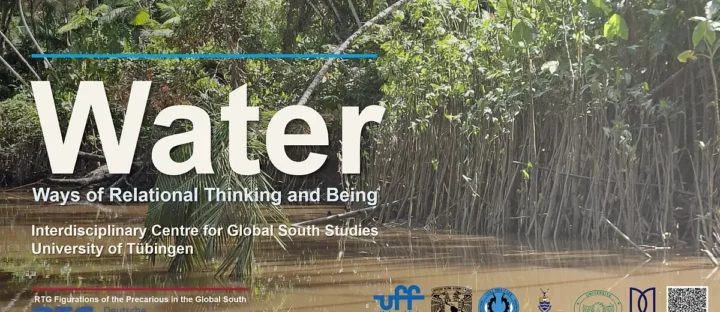
The Interdisciplinary Center for Global South Studies, together with its partner universities, dedicates the seventh International Forum to water: as a substance and a medium, as a way of thinking, and as an ever scarcer commodity. Access to water is central to the survival of humans, animals and plants alike, and lies at the heart of some of today’s most intractable economic and political conflicts.
Taking up the epistemologies of confluence (Bispo dos Santos) and the idea of a world of many worlds (de la Cadena and Blaser), the Forum approaches water as an analytical tool for reading life on our planet across the humanities, the social and political sciences, the earth sciences, and artistic and activist practice. Thinking through water in its material and symbolic dimensions, as water bodies, hydrological ecosystems, hydro-infrastructures and oceans, opens up questions about the relationship between nature and culture, about social practice and political agency, and about what extraction and colonial modernity have done to territories, bodies, languages and memories. Because water is governed as either too much or too little, the Forum attends equally to its absence, bringing oceanic and water studies into dialogue with desert studies.
Over two weeks, scholars, activists and artists from Africa, Asia, Latin America and Europe meet in panels, keynote lectures, workshops, screenings and artistic interventions, on site in Tübingen and at partner universities, and online. Sessions are held in English, Spanish, French and Portuguese.
Topics include the climate crisis, hydropolitics and geopolitics, indigenous knowledges of water, figurations of water in literature, media discourses and the arts, memory and archive, island and ocean studies, blue humanities, the militarization of water, and gendered relations with water.
Contact: internationalforumtuebingen@gmail.com
14:00-15:30 – Panel 3 (EN)
Hydrocolonialism, extraction and disposal
1. Hydrocolonialism, Extractivism, and Biopolitics in Helon Habila’s Oil on Water and Imbolo Mbue’s How Beautiful We Were ( Lassana Kanté , Université Cheikh Anta Diop, Senegal)
2. Hydropolitics and Self-Provisioning in Postcolonial Côte d’Ivoire: SODECI, Water Distribution, and Urban Water Scarcity ( Ahmadou Siendou Konaté , Université Félix Houphouët-Boigny, Côte d’Ivoire)
3. Undamming the River: Confronting the Absence of Dam Removal in the Global South ( Monti Aguirre , International Rivers)
4. Amazonia, A World of Water: Rethinking rivers and infrastructure in the early twentieth century ( Javier Uriarte , Stony Brook University, United States)
Link access: zoom.us/j/98649288365 ;