Dam Drawdown an Overlooked "Global Warming Culprit"

By: 
Katy Yan
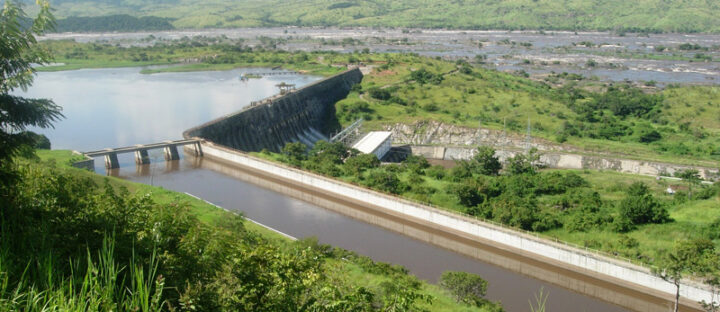
Marshes in the drawdown area of the Three Gorges Reservoir could be a significant source of methane.
Photo: Wikimedia Commons

While scientists have known for decades that tropical reservoirs are a significant source of greenhouse gas emissions, new research from Washington State University-Vancouver has revealed that temperate reservoirs can produce a significant surge in emissions during certain times in their operation. These periods are known as drawdown periods, when the water level in a reservoir drops rapidly, thereby exposing a "drawdown zone" of decayed plants that can be a continuous source of methane.

Bridget Deemer, the researcher leading the study, measured dissolved gases in the water column of Lacamas Lake in Clark County and found methane emissions jumped 20-fold when the water level was drawn down. A fellow WSU-Vancouver student, Maria Glavin, sampled bubbles rising from the lake mud and measured a 36-fold increase in methane during a drawdown. Deemer and Glavin will present their findings at a poster session at the national meeting of the Ecological Society of America in Portland this week.

While emissions from drawdown regions have long been recognized by researchers and international research bodies like UNESCO (see UNESCO and International Hydropower Association's Greenhouse Gas Measurement Guidelines), according to John Harrison, Deemer and Glavin's advisor and an assistant professor of Earth and Environmental Sciences, this is the first study to actually demonstrate and quantify the relationship between water-level drawdowns and greenhouse gas releases. 

This is also one of the few studies we've seen to actually examine drawdown zones in temperate reservoirs. Drawdown emissions have been studied and modeled in the tropical context (see Fearnside, 2009 and 2005) and to a limited extent at the Three Gorges Dam (see Chen, H. et al., 2009). In the case of Three Gorges, for instance, one-third of the reservoir is a drawdown region and given its massive size (its surface area is the size of Hong Kong), that is no insignificant source of methane. While dam reservoirs cover a small portion of the earth's surface, as Harrison notes, they harbor biological activity that can produce large amounts of greenhouse gases. When you think of the number of large dams in the world – more than 54,000 that are over 15 meters – and the countless others that are being proposed or are under construction, continuing to overlook reservoirs as a carbon source and treating dams as a "carbon neutral" energy source is no longer a viable option.

Fallen tree at Lacamas Lake, Washington
Photo: Lonie Lougheed

To fix this situation, an important first step is for governments and dam builders to recognize that dams have a carbon footprint (and a potentially significant one depending on where it's located, its age, depth, and organic inputs). Next, countries must report their reservoir emissions in their national greenhouse gas inventories. However, since the requirement is that they follow IPCC guidelines, the IPCC must first adopt strong guidelines like those developed by UNESCO/IHA. Only then can we get a true accounting of a country's overall carbon emissions.

On the project scale, this research could have important implications for how dam operators manage drawdowns, as emissions may be higher in summer months when warmer temperatures and low oxygen conditions in bottom waters stimulate the microbial activity that produces greenhouse gases. Managers can also consider the optimal time to take out a dam, according to Deemer. While a dam removal may lead to some greenhouse gas emissions initially, it will be a one-time occurrence, whereas emissions can recur with regular drawdowns. With this in mind, Deemer plans to look at three other reservoirs in Oregon and northern California's Klamath basin, where a major dam decommissioning effort is underway.

More information: 

Comments

These "researchers" should take into consideration what percentage of the Earth's surface is covered by such man-made reservoirs compared to the oceans and other natural bodies of water. They'll quickly conclude that even if methane emissions from reservoirs were to increase for brief periods by two orders of magnitude, it would be insignificant on a global scale.

Many deniers have the same comments about human-caused emissions, saying they are too small to change our vast atmosphere and warm the planet. Considering that we have now warmed the planet by just under 1 degree Celsius (as noted in several recent studies) and considering that methane is a much more potent green house gas, we don't have the luxury of overlooking possible sources of methane plumes, especially those that we created.

That 1 degree Celsius "warming" is largely due to the paint on Stevenson screens — the white louvered boxes at weather stations that contain the thermometer, hygrometer and barometer — changing from whitewash to latex paint around 1979. Moreover, recent surveys have shown that many weather stations are improperly sited and constructed, being affected by hot air on blacktop parking lots, warm air conditioning exhaust near buildings and hot air and exhaust from vehicles. Satellites have measured virtually zero global average sea surface temperature change since the mid 1960s These are facts; look them up. Don't be a sap and call everyone who disagrees with the totalitarian drumbeat a "denier". The alleged global warming is due largely to instrumentation error, and so Henny Penny has been running around for the last 20 years telling us that the sky is falling. It would be laughable, except for the terrible price these lies have been exacting from people around the world for the benefit of a few fraudsters and schemers.

Right. there's no warming. The glaciers are not melting. The sea levels are not raising. The animals, birds, insects are not migrating north or changing their seasonal rhytmns. Plants are not budding or blooming earlier. Weather patterns are not changing. The Earth is flat and is the center of the universe.

Go back to the river in Egypt!

The accumulation of knowledge seems to disturb some, since they already have the definitive facts on everything..... The above article simply states Dams have a carbon footprint which could be significant because of methane release during Dam draw down and that this should be considered. No more no less. It must be nice to know everything already Phil Cooper..

Where does it say that a "carbon footprint" is of any significance whatsoever, Wayne? We're all carbon-based life forms. Perhaps we should simply wipe the human race off the face of the globe. This is called "anti-humanism" and has been the demonic force behind social Darwinism, eugenics, the two World Wars, and now the man-made global warming/climate change nonsense. People who believe we need to reduce carbon footprints obviously slept through biology class in high school when the carbon cycle was being discussed. The amount of carbon in the environment is constant; it gets continuously recycled. No cause for concern.

How did you possibly graduate from HS with such a total lack of thinking ability?

Yes, the amount of carbon on the planet is constant but its form and location is not.

Carbon in solid, liquid or even gaseous (coal, oil & gas), hydrocarbon forms that had been buried deep underground for millions of years is now circulating in the atmosphere as gas. We're adding millions of tons each year.

FYI, The atmosphere is part of the environment; deep underground reservoirs are not.

I not only managed to finish high school, but went on to get advanced degrees in engineering and business, Art. Further, to successfully complete engineering studies, acquire engineering registration from one's state and work for several decades in private enterprise, one needs to have proven thinking ability. As a part of my engineering education I studied calculus and advanced engineering analysis, where I learned about rates. Yes, we may be adding millions of tons [of carbon] each year, but it also means that millions of more tons are being recycled by nature. It's all about proportions and rates, Art. Remember that. The vast majority of carbon on Earth is locked up in limestone. The little bit that we release into the atmosphere is an insignificant quantity in comparison, and an even less significant quantity in effects on the environment. Carbon is a very POOR greenhouse gas compared to water, pound for pound. There is MUCH more water in the atmosphere and nearly 80 percent of the Earth's surface is covered by water. We should be far more concerned with reducing water emissions than carbon emissions and taxing individuals for exhaling water vapor, yet nobody seems to be doing anything about this gigantic problem. See how stupid these arguments about carbon in the environment become in very short order?

Thanks everyone for the scintillating discussions! Just to respond quickly to the comment that carbon footprints are insignificant - I think I was awake in biology class for both the lesson that we are carbon-based, and the lesson on photosynthesis and the carbon sequestration role of our forests and oceans. True we all naturally produce carbon, and that carbon is cycled backed into the oceans, soils, sediments, etc as part of the carbon cycle (yet another biology lesson!). Yet when we disturb the balance of that carbon cycle by adding a massive amount of greenhouse gases into the atmosphere through our consumptive activities, we change the equation of the carbon budget (i.e. the balance of the exchanges of carbon between sources and sinks; check out the IPCC page, they have a host of great graphs and info). Why should we care? Because this leads to a host of impacts - either direct or through positive feedback loops - that we are all experiencing now, but most of all, hurt the poorest and most vulnerable communities and nations in the world. I'm glad you brought up biology class - climate science education is critical. But it also won't be enough unless we also see this as a moral and ethical issue. We are not only condemning the ever-growing communities living in low-lying, drought-stricken or flood-prone areas to greater and more frequent extreme weather events and natural disasters, but also our children and their children's futures. For just a few perspectives on this ethical dimension, see the following commentaries by scientists that have been willing to speak out on our moral obligation: Dr. Rajendra K. Pachauri, http://news.bahai.org/story/729; Jim Hansen, http://www.guardian.co.uk/environment/2012/apr/06/nasa-scientist-climate.... And one by Severn Cullis-Suzuki, who in 1992 and again in 2012 addressed a crowd in Rio on behalf of children everywhere: http://www.democracynow.org/2012/6/21/at_rio_20_severn_cullis_suzuki. This is definitely not a moment to fall asleep.

Although the authors may have measured an increase in methane when the reservoir was drawn down, by itself, this does not say anything about the net gain or loss of carbon in the environment.

Where did the carbon in the "decaying plants" come from? What would its destination have been had remained underwater?

Thanks Art K, great point. We can only get an accurate picture if the entire carbon budget of a system is calculated. That requires resources and more research, but it's important and can now be done better with new guidelines such as UNESCO's. But this drawdown research is an important piece in the puzzle. Depending on the temperature, depth, and age of this reservoir, these underwater plants would also have produced methane through diffusion and ebullition. For an example study, see: April, G. et al. (2005) ‘Carbon dioxide and methane emissions and the carbon budget of a 10-year old tropical reservoir (Petit Saut, French Guiana),’ Global Biogeochemical Cycles 19.

Art K is right on the money. Without knowing what the reservoir area produced for green house gases pre-reservoir, you can't say whether the current reservoir produces more or less atmospheric carbon than before. The fact that a reservoir drawdown produces a relative burst of methane doesn't mean it produces more methane in total, or sequesters more carbon in total, than a pre-reservoir condition. We need to have more rigorous scientific thinking before suggesting a study like this is particularly useful for concluding anything as sweeping as some have suggested.

Thanks Tim for your words of caution. I'm not sure any of us or the researchers cited in this blog are suggesting that this study proves that Lacama Lake is a net carbon source. Rather, it's significance lies in the fact that: (a) it reveals the importance of an under-researched area – drawdown zones; and (b) it debunks the myth that only tropical dams emit significant amounts of methane. Drawdown emissions should be included in the overall measurements and calculations of a reservoir's carbon budget. Other gaps in research include studies on net emissions, the contribution of nitrous oxide from reservoirs, better predictive models, and having a greater temporal and geographical spread in studies (so far most studies are from the tropics). There is some great research being done that I encourage everyone to check out either on the Bibliography link above or here: http://www.internationalrivers.org/node/3764.

I monitor the temperature anomalies from all five reporting agencies. I average them to avoid bias. Anyone else actually paying attention is aware that the planet stopped warming over a decade ago. Meanwhile, the atmospheric carbon dioxide has increased since 2001 by 25% of the increase from 1800 to 2001. This demonstrates that we have been deceived and average global temperature is actually insensitive to the level of atmospheric CO2.

Here's a new resource on commonly heard climate denialist arguments, and the responses, sourced from IPCC: http://www.opr.ca.gov/s_commondenierarguments.php. The two important questions I see here are: (a) How much are we willing to risk (in terms of financial losses, biodiversity loss, cost of disaster management, lives and livelihoods, etc.)? and (b) Do we the privileged citizens of the world have a moral obligation to help those being presently and directly impacted by climate destabilization? For the first question, see the late Steve Schneider's testimony to Congress, where he lays out the cost of inaction compared with the pittance we'd pay with action: http://stephenschneider.stanford.edu/Publications/PDF_Papers/SchneiderTe.... For the second question, that requires an open and honest debate at all levels of society.

Add new comment

By submitting this form, you accept the Mollom privacy policy.

Facebook

Twitter

Mailing lists

We offer many campaign-specific email lists to help you stay informed.

Sign up for urgent campaign actions and NewsStream: